In the spring of 1950, deep in the shadowy forests of Karelia, a young wildlife photographer stumbled upon a scene as heartbreaking as it was unforgettable—a wide-eyed bear cub standing over the still form of its mother, killed by a passing car. The cub lingered there, trembling with confusion, before slipping silently into the trees.
Researchers who later saw the photograph believed the little bear’s days were numbered. So young, so inexperienced, and without its mother’s protection, survival in the harsh northern wilderness seemed impossible.
But nature, as it often does, defied expectation.
Ten years later, in 1960, the same research team returned to Karelia, this time tracking wolf movements. In a sunlit clearing, they spotted three wolves standing alert—and behind them, an enormous brown bear. But instead of tension, there was ease. The wolves and bear moved together, their body language harmonious, like kin.
Then the bear stepped forward, and the researchers saw it—a small notch in its left ear, identical to the one the orphaned cub bore in that old photograph. It was the same animal, grown strong and impossibly alive.
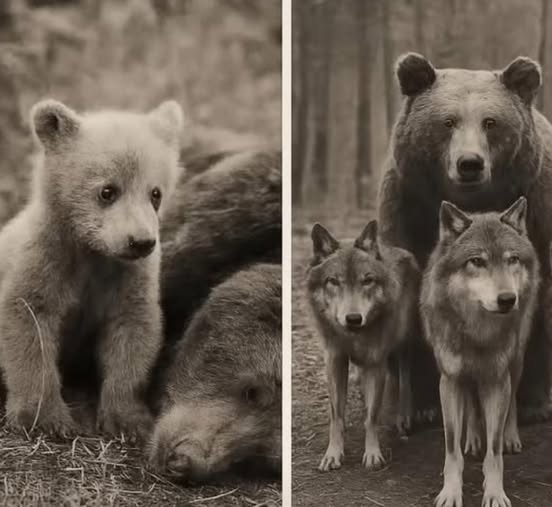
Against all odds, the cub had been taken in by the wolves, raised among them, taught to hunt and survive as one of their own.
It had become a living legend—proof that in the wild, family isn’t always bound by blood, but by the unspoken laws of loyalty and survival.