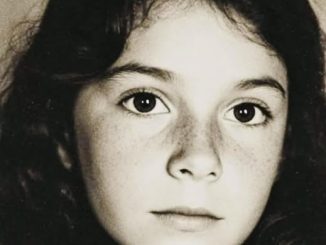
In late-1960s Germany, when the world outside was changing at a dizzying pace, a quiet farmhouse in Klingenberg began to harbor a much darker transformation. Anneliese Michel, a shy, devout teenage girl, started behaving in ways that terrified even those who loved her most.
It began subtly — strange moods, sudden tremors, moments she couldn’t explain. But soon the changes grew violent, uncontrollable.
She tore the clothes from her body as if the fabric itself were burning her skin.
She knocked crucifixes from the walls, scattering splintered icons across the floor.
She shredded rosaries with her bare hands, the beads snapping like tiny bones.
Sometimes she crawled under the kitchen table and stayed there for hours, growling and barking like a feral animal. Other days, she dropped to her knees and did 400 squats in a row, her body shaking, her eyes distant, as though she were trying to outrun something only she could see.
She refused food, even when trembling with hunger. When her family begged her to eat, she whispered in a hollow voice:
“I’m not allowed. They won’t let me.”
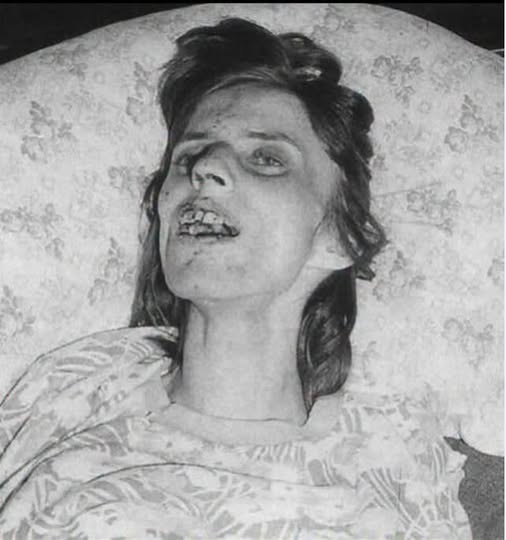
Instead, she chewed on spiders, flies, and lumps of coal, as if compelled by something beyond reason.
Doctors saw epilepsy. Priests saw possession. Her parents saw their daughter slipping away.
For months, two priests carried out the rarest of rituals — an official, sanctioned exorcism. Forty-seven sessions, each more desperate than the last. And during these long nights, the soft-spoken girl they once knew would twist her face into grotesque expressions, speaking in voices that did not belong to her.
On June 30, 1976, during her final session, Anneliese was too weak to stand. Her voice, once filled with the sweetness of a choir singer, was thin and broken.
Her last recorded words were chilling in their simplicity:
“Please… beg for absolution.”
and later,
“Mother… I’m afraid.”
The next morning, Anneliese Michel was gone.
Her story became one of the most debated tragedies of the century — part medical mystery, part religious controversy, part human heartbreak. But beneath all the legends, arguments, and horror films inspired by her suffering, one truth remains:
Anneliese was not a monster or a myth.
She was a young woman who fell into a darkness no one around her knew how to escape