You know where to find me? Right in the middle of my garden.
There’s something deeply satisfying about getting your hands in the soil, watching seedlings sprout, and seeing pollinators dance from bloom to bloom.
But let’s be honest — gardening isn’t always peaceful.
Pests happen.
And sometimes, what looks like a problem… turns out to be part of the solution.
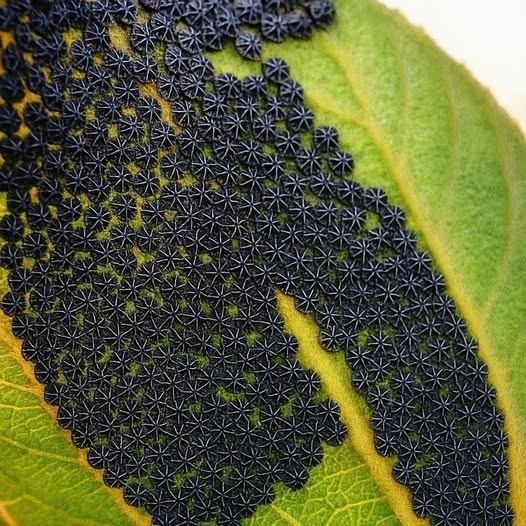
Recently, I came across a photo making the rounds online — a leaf covered in intricate black clusters, arranged in neat rings or zigzags. At first glance, it looked alien. Eerie. Like something out of a sci-fi movie.
My first thought? “Oh no — is this destroying my plants?”
Turns out, it’s not a disease.
It’s not even harmful.
Those mysterious black patterns?
👉 They’re butterfly eggs — specifically, those of the Mourning Cloak butterfly (Nymphalis antiopa).
And far from being a threat, they’re a sign your garden is doing something very right.
Let’s explore what these tiny geometric wonders really are — and why you should leave them alone… not because they’re dangerous, but because they’re precious.
🦋 Meet the Mourning Cloak Butterfly
The Mourning Cloak is one of North America’s most striking and long-lived butterflies:
Deep maroon wings edged with bright yellow
Black margins with iridescent blue spots
One of the first butterflies seen in spring — sometimes even flying in winter during warm spells
These beauties can live up to 12 months, which is rare for butterflies (most live just weeks).
They overwinter as adults under bark or in tree cavities — emerging early to lay eggs on host plants.
🥚 What Are Those Black Geometric Clusters?
Those dark, circular bands on leaves aren’t pests or fungus — they’re egg masses laid by female Mourning Cloaks.
Here’s what makes them special:
Laid in tight rings around twigs or stems — often on elm, willow, poplar, or birch
Each cluster contains dozens of tiny, barrel-shaped eggs
Dark red when first laid, turning grayish-black within a day
Protected by a tough outer shell that deters predators
✅ The “alien lattice” effect? Just nature’s brilliant design.
When the eggs hatch, tiny black spiky caterpillars emerge — social feeders that stay together in silken nests at first, munching on tender new growth.
🐛 What Happens After Hatching?
Tiny caterpillars emerge in spring
Feed communally inside silk nests on branches
Molt several times, growing larger and more bristly
Disperse before pupating into chrysalises
Emerge as stunning adult butterflies — some migrate short distances
💡 Fun fact: Mourning Cloak caterpillars use their numbers and spines to deter birds — but they’re harmless to humans.