The real eldest von Trapp daughter lived to 97 and spent her final years correcting the lies Hollywood told about her family.
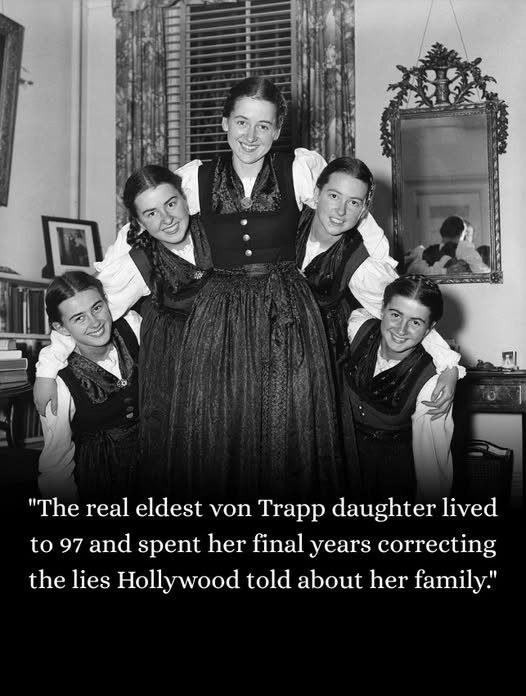
Her name was Agathe von Trapp, and if you’ve seen “The Sound of Music,” you think you know her story.
You don’t.
Born in 1913 in Pola, Austria-Hungary (now Croatia), Agathe grew up in a world of music and privilege. Her father was a decorated naval hero. Her home was filled with song. When her mother died, leaving seven children behind, a young woman named Maria came to be their governess—and eventually, their stepmother.
So far, Hollywood got that part mostly right.
But here’s what the movie didn’t show: Agathe wasn’t a sheltered, innocent girl playing games in the Austrian Alps. She was a serious musician with a trained soprano voice. She and her siblings weren’t just singing for fun—they were developing into one of the most accomplished vocal ensembles of their era.
When the Nazis annexed Austria in 1938, the von Trapp family made a choice that would change everything. They could stay and prosper under the Third Reich—Captain von Trapp had been offered a position in the German navy, and the family could have enjoyed wealth and prestige.
Or they could walk away from everything.
They chose freedom.
But they didn’t escape over mountains in a dramatic midnight flight like the movie shows. The reality was both more mundane and more terrifying: they took a train to Italy, pretending to be going on a singing tour. They left behind their home, their possessions, their entire life.
They never went back.
By 1940, the von Trapp family arrived in America—refugees with little money, limited English, and seven children to feed. In Europe, they’d been aristocracy. In America, they were immigrants starting from zero.
So they did what they knew how to do: they sang.
The Trapp Family Singers toured relentlessly throughout the 1940s. Not glamorous concert halls at first—small churches, town halls, anywhere that would book them. Agathe, now in her twenties and thirties, spent over a decade on the road, performing hundreds of concerts a year.
The work was exhausting. The travel was brutal. But they were building something: a reputation, a livelihood, a new life in a country that had given them refuge when their own homeland fell to darkness.
By the early 1950s, Agathe had had enough.
While “The Sound of Music” ends with the family fleeing to freedom and presumably living happily ever after through music, Agathe’s real story took a different turn. She left the family singing group and became a kindergarten teacher in Maryland.
Think about that choice. She could have continued performing, touring, basking in the growing fame of the Trapp Family Singers. Instead, she chose a quiet life working with children.
For decades, she lived in relative obscurity while “The Sound of Music” became one of the most beloved films in history. Released in 1965, the movie turned her family’s story into a global phenomenon—but it was a story Agathe barely recognized.
Hollywood had smoothed the rough edges. Romanticized the hardships. Changed key details. Turned real, complex people into archetypes.
And for years, Agathe watched as millions of people around the world thought they knew her life story—but didn’t.
Finally, in 2003, at age 90, Agathe co-authored “Memories Before and After The Sound of Music.” It wasn’t written in bitterness—rather, it was a gentle but firm correction of the record. The real story, she wanted people to know, was more complicated, more difficult, and more meaningful than Hollywood’s version.
The real Maria wasn’t quite the sunny, singing saint of the movie. The real escape wasn’t a midnight mountain climb. The real life in America wasn’t an instant happy ending—it was years of hard work, adaptation, and perseverance.
Agathe lived to see her family’s story become legend. She lived through world wars, the loss of her homeland, the building of a new life in a foreign country, and the strange experience of watching Hollywood fictionalize her childhood.
When she died on December 28, 2010, at age 97 in a hospice near Baltimore, she was far from the spotlight. No paparazzi. No red carpets. Just a quiet ending for a woman who’d lived an extraordinary life on her own terms.
She’d been a refugee, a professional singer, a teacher, an author, and a witness to history.
But perhaps most importantly, she was a reminder that the real story—the one with all its complexity, difficulty, and truth—is always more remarkable than the Hollywood version.
“The Sound of Music” will live forever in popular culture, and that’s fine.
But Agathe von Trapp lived a real life, not a movie. And in the end, she made sure we knew the difference.