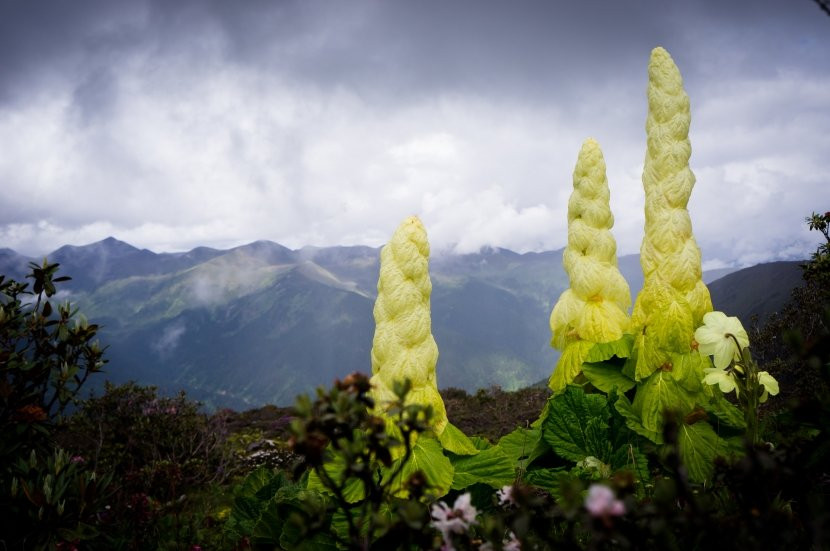
Hidden among the clouds of the Himalayas, on wind-swept slopes where few plants can survive, there stands a mysterious golden tower — a plant that waits decades before revealing its final blossom. Locals call it The Golden Tower Cabbage, but scientists know it as Rheum nobile — one of the most extraordinary alpine species on Earth.
A Living Miracle of the Mountains
At elevations above 4,000 metres, the air is thin, the wind harsh, and temperatures drop below freezing even in summer. Yet here, among the rocks of Tibet and the Himalayas, Rheum nobile thrives.
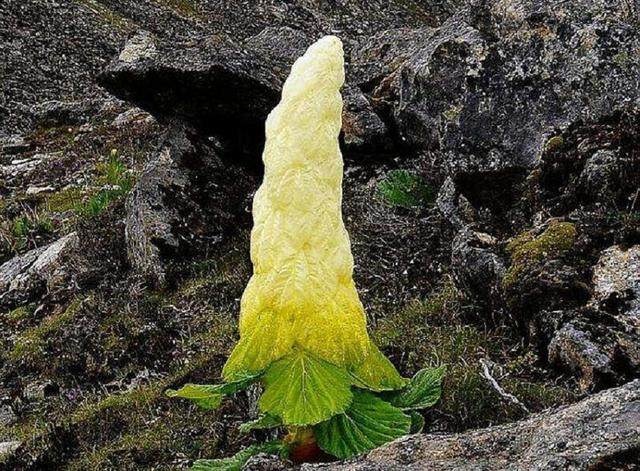
From afar, it looks like a glowing tower of light — its translucent, golden bracts shining under the sun, as if the plant itself were made of amber. These bracts protect the fragile flowers within from ultraviolet radiation and icy winds, creating a natural greenhouse at the heart of the storm.
“It looks like a lamp lit by the gods,” say Tibetan herders who often encounter the plant during long pilgrimages.
The 20-Year Patience
Unlike most plants, Rheum nobile lives in slow motion. It spends 15 to 20 years — sometimes even 40 — gathering strength underground. Season after season, it endures snow, drought, and thin mountain air, growing quietly in its rocky cradle.
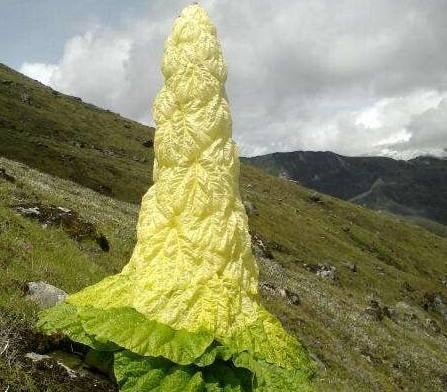
Then, one miraculous summer, it sends up a towering stalk — up to two metres tall — crowned with hundreds of small flowers glowing gold. The bloom lasts only a few weeks… and then, the plant dies.
This rare one-time flowering makes it a monocarpic species — one that blooms only once in a lifetime. But before dying, it scatters thousands of seeds to the wind, ensuring that the golden towers of Tibet will rise again someday.
More Than Just a “Cabbage”
Despite its nickname, Rheum nobile isn’t a cabbage at all. It belongs to the rhubarb family (Polygonaceae), closely related to the garden rhubarb used in pies and herbal medicine. However, this alpine cousin is far rarer — found only in the highlands of Tibet, Bhutan, and western China.
Locals treasure it not just for its beauty but also for its healing properties. In Tibetan medicine, extracts from its roots and stems are used to treat wounds, digestive disorders, and throat inflammation. Because it grows so slowly, wild specimens are considered sacred and are harvested with deep respect — or not at all.
A Natural Tower of Strength
Scientists studying Rheum nobile have discovered that its golden bracts act like a natural UV shield and heat trap. Inside the “tower,” the air is several degrees warmer than outside, allowing pollination to occur even in freezing winds. This adaptation is a masterpiece of mountain evolution — a plant that built its own survival chamber.
Its deep root system also stabilizes the loose, rocky soil of the Himalayas, helping to prevent erosion. In this way, the Golden Tower isn’t just a survivor — it’s a silent protector of its ecosystem.
Rare and Endangered Beauty
Because of its slow growth and one-time bloom, Rheum nobile is extremely vulnerable. Increasing tourism, overharvesting, and climate change threaten its fragile habitat. Conservationists now urge travellers to admire it without picking or disturbing it — to let the mountain’s miracle continue.
“Every flower takes decades to prepare its moment,” says a Tibetan botanist. “Destroy one plant, and you erase 20 years of life.”