In 2020, a pilot gliding over the still, mirror-like waters of Kootenay Lake in British Columbia spotted something strange and mesmerizing just beneath the surface—a swirling, geometric pattern spanning nearly 200 meters across the lakebed.
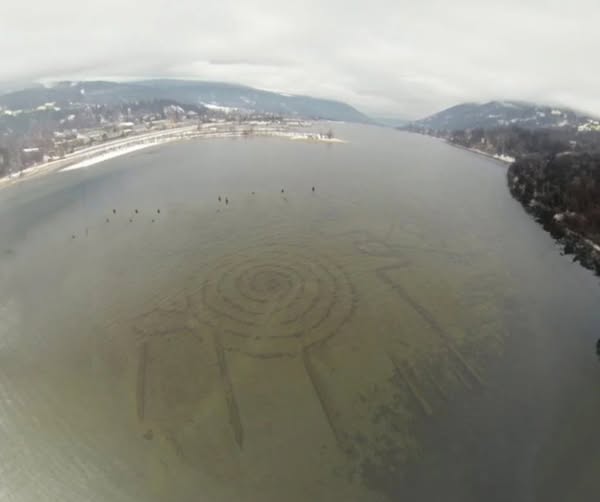
Its precision echoed ancient petroglyphs or crop circle geometry, sparking immediate intrigue. Was it a forgotten cultural relic, a message left in stone, or simply a natural phenomenon crafted by time and ice? When divers descended, they found that the pattern wasn’t carved into the rock, but built—carefully arranged from river stones, some as large as footballs. What truly deepened the mystery was how certain lines within the design aligned with the sun’s angle during the solstice, but only when the water dropped by six meters—a condition last known before a 1930s dam raised the lake’s level. Sonar mapping hinted at more: perhaps the formation was only part of a larger complex, hidden under layers of silt. Theories poured in—ancient calendar, ceremonial site, or glacial illusion? Yet none quite settled the matter.
Elders from the Ktunaxa Nation recalled water spirits shaping the land, but no oral story matched the formation’s design. Scientists debated: some pointed to patterns from glacial retreats, others quietly wondered about the work of long-lost civilizations.
As it rests quietly beneath the lake, invisible from the shore but unmistakable from the sky, this formation—now dubbed the “Nazca Lines of the North”—remains one of Canada’s most haunting and unresolved archaeological puzzles.