You reach into the bread bag for a quick sandwich.
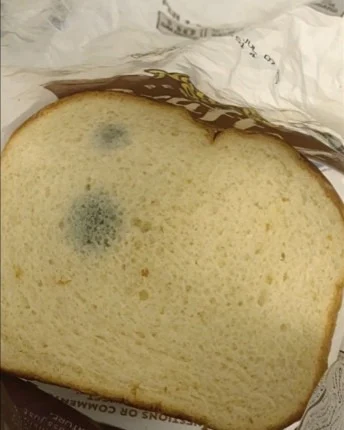
Then you see it — a fuzzy blue-green spot on one corner of the loaf.
“It’s just one small patch,” you think. “If I cut it off, the rest should be fine… right?”
Wrong.
Unlike hard cheeses or salami, mold on bread means the entire loaf is likely contaminated — even if only one part looks affected.
et’s explore what mold really is, why you should never eat moldy bread, and how to store your loaves safely — so you can protect your health and reduce food waste wisely.
Because real food safety isn’t about panic.
It’s about knowing when to save — and when to throw away.
Mold is a type of fungus that grows in multicellular filaments called hyphae. These thread-like structures spread through porous materials — including bread — often far beyond what’s visible to the naked eye.
✅ Blue-green: Penicillium species (yes, same family as penicillin — but not safe to eat)
✅ White (fuzzy film): Early-stage mold, often mistaken for flour dust
✅ Black or gray: Aspergillus, Rhizopus— some can produce harmful mycotoxins
📌 Mold thrives in warm, moist environments — making your kitchen counter a perfect breeding ground.
❌ Why You Should Never Eat Moldy Bread
There Might Be More Mold Than You See
Kazanchyan explains that moldy bread is a sign that it is spoiled, and once food spoils, it can be hard to isolate what is most harmful. So even if it’s not the mold that’s the problem, moldy bread is problematic. And while you might not be able to see mold on every slice, that doesn’t mean it isn’t there.
“There is a lot of microscopic activity going on that the eye cannot see. The spores are like the tip of the iceberg; the majority of the fungal growth is actually beneath the surface. By touch, you may feel slightly more density in the area where the mycelium is present. Mycelium is a web-like structure that breaks down nutrients visually, similar to the root system of a tree,” says Garrison.
What Happens if You Eat Moldy Bread?
When it comes to bread, surface mold isn’t just ugly and unpalatable; it can be unsafe. “Mold can trigger respiratory issues such as asthma and allergic reactions, which will range in severity depending upon the sensitivity of the individual,” says Garrison.
It’s hard to say for sure how dangerous a particular loaf of moldy bread can be to your health. “Without testing the sample in a lab, you cannot be certain that particular mold strain will or will not produce mycotoxins, which could be fatal,” says Garrison.
But it’s best to play it safe and not eat bread with mold. Kazanchyan and Garrison agree that populations at higher risk, such as babies, small children, pregnant individuals, older people, and those with a compromised immune system, should avoid contact with mold whenever possible.
How to Store Bread to Prevent Mold
Generally, bread is stored at room temperature because refrigeration causes the starches in bread to recrystallize and become dry. Our experts suggest freezing bread you don’t intend to eat in a day or two, rather than refrigerating it. They say freezing is best for longer storage in terms of preventing spoilage, including mold, and preserving not only freshness but flavor and texture.