Sometimes prehistory doesn’t emerge through excavation — it appears when the present recedes. That’s what happened in Texas when a severe summer drought shrank the Paluxy River and exposed something extraordinary beneath the muddy water: dinosaur tracks more than 113 million years old.
Dinosaur Valley State Park, near Fort Worth, is known for its ancient footprints, but many of them usually lie hidden under flowing water, sediment, or algae. Only when conditions are just right — or just extreme — do they surface. This year, as the river thinned into narrow channels, the limestone bed hardened in the heat and revealed astonishingly crisp impressions left during the Early Cretaceous.
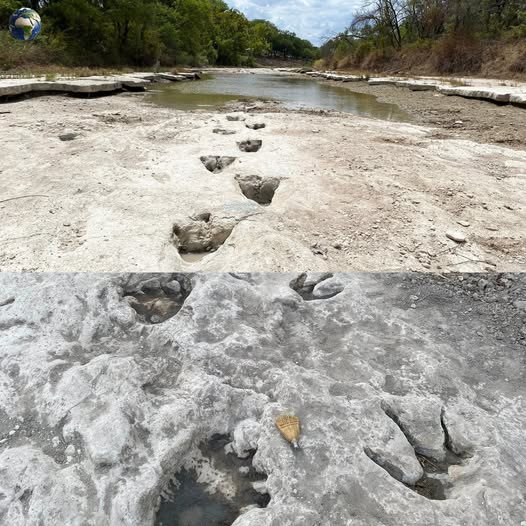
Some of the newly uncovered tracks belong to Acrocanthosaurus, a powerful carnivore that stalked the floodplains of ancient Texas. Others trace the steps of Sauroposeidon, a massive long-necked herbivore whose footprints sink deep and broad into the once-soft mud. Together, they form a map of movement frozen for over a hundred million years — strides, slips, and splay marks preserved with surprising clarity.
What makes drought-revealed tracks so striking is the immediacy of the moment they capture. These footprints were made in a matter of seconds: one dinosaur lifting its foot, water filling the depression, mud settling, and time sealing it all away. Then they vanished under shifting rivers for generation upon generation, waiting for conditions harsh enough to bring them back.
This summer’s drought, part of a broader pattern affecting landscapes worldwide, has unearthed forgotten towns, sunken boats, ancient bridges — and now, the literal footsteps of giants. While their reappearance is scientifically valuable, it’s also bittersweet. These tracks return not through slow geological change, but through rapid environmental stress.
Still, standing in the riverbed, looking at prints pressed into stone by animals long gone, it’s impossible not to feel the weight of deep time.
A vanished world rises when the water falls.