When John Sims purchased a friend’s modest home in Tucson, Arizona, he didn’t expect the property to come with a mystery. But soon after settling in, he heard a curious rumor — that something unusual was buried somewhere in the backyard. At first, he brushed it off as neighborhood folklore. But the idea nagged at him. What if there was something more?
Driven by curiosity, John began to investigate. He started digging, not just in the literal sense, but through historical records, local building permits, and archives. His search eventually uncovered a surprising lead: a permit from 1961 tied to a company called Whitaker Pools, known at the time for building not only swimming pools but also nuclear fallout shelters during the Cold War.
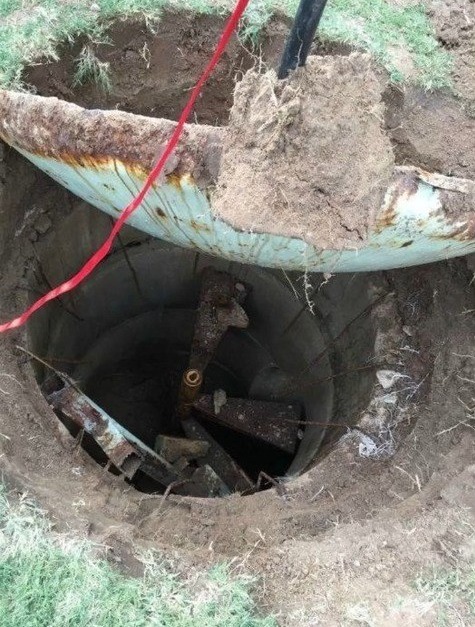
The early 1960s were a period marked by deep anxiety over the threat of nuclear war. With the U.S. and Soviet Union locked in a tense arms race, civil defense became a national priority. Across the country, families built underground shelters in their backyards, stocked with canned food, water, and emergency supplies — hoping to protect their loved ones in the event of a nuclear strike.
With this context in mind, John became even more determined to find out what lay beneath his property. He enlisted the help of a local team of metal detector hobbyists, hoping their equipment could pick up something buried beneath the soil. After several sweeps, their devices pinged on a spot in the backyard — and just three feet below the surface, they hit something solid.
Inspired by the response and recognizing the historical significance of what he had found, John decided to restore the space and turn it into a mini-museum dedicated to the Cold War era. He began carefully cleaning and preserving the items, adding educational placards and guided tours for local visitors and school groups. The shelter became more than just a curiosity — it became a tool for educating people about a time when fear of nuclear war shaped daily life.
John’s passion project grew into a community conversation. Neighbors who had never considered the history beneath their homes began digging into records, some even finding forgotten shelters or fallout supplies of their own. Local historians and journalists took note, and the shelter gained media attention as a rare, preserved example of 1960s civil defense planning.
The bomb shelter, with its claustrophobic space, old supplies, and sturdy design, now stands as a powerful reminder of how ordinary families prepared for extraordinary threats. It’s a sobering glimpse into a past where geopolitical tensions shaped backyards and daily routines — and where survival was something people quietly planned for, even if they hoped they’d never need it.
In the end, John Sims didn’t just find a shelter — he unearthed a piece of American history, hidden beneath layers of dirt and decades of change. And in doing so, he reminded his community that sometimes, the past is much closer than we think — just waiting to be rediscovered beneath our feet.