For twenty years, an eagle soared across continents.
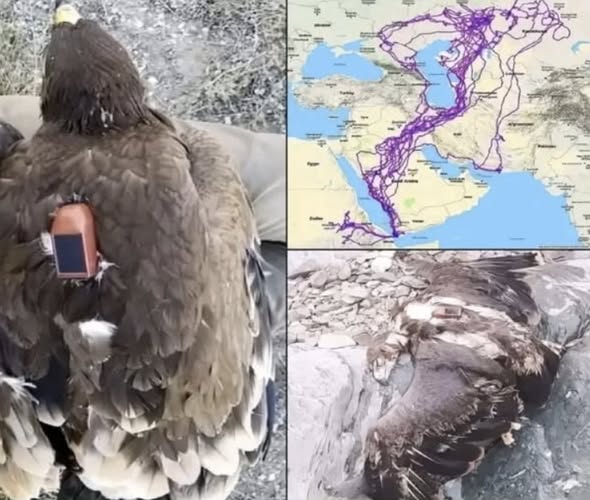
Researchers in Russia had fitted her with a GPS tracker, and for two decades she traced the wide, sun-burned steppe with unbroken wings. When she finally took her last flight, she died far away in Saudi Arabia’s Valle del Niño — but the record of her journey remained.
And that journey was astonishing.
She crossed mountains, deserts, plains, and nations.
But there was one place she never crossed — the sea.
Though shortcuts stretched across the water like open doors, she chose instead to circle entire seas and coastlines, flying hundreds of miles farther than she needed to. At first glance, it made no sense… until we understood why.
Steppe eagles rely on thermals—columns of warm air rising from the ground. These currents lift them effortlessly, allowing them to glide across the sky with almost no energy. Over the open sea, those thermals vanish. There is no warm land to feed them. To cross the water would mean constant wing-beating, rapid exhaustion, and death.
So the eagle avoided the sea.
Not by thought, but by instinct — by ancient, inherited wisdom written into bone and feather.
What looks like a wandering, looping route is actually a masterpiece of survival:
A map drawn not with ink, but with life.
This is the silent intelligence of nature — a wisdom older than language, older than memory.
The eagle’s journey shows us something profound:
Survival isn’t just strength.
It’s understanding the world so deeply that you move with it — not against it.
Her flight path is not just a trace of where she traveled.
It is the story of how she lived.